
When to Visit Croatia and Slovenia — A Real Answer, Not Just “Avoid August”
This guide covers the Croatian Adriatic coast, Dubrovnik, Split, Plitvice Lakes, Ljubljana, and Lake Bled. It does not cover eastern continental Croatia or winter ski itineraries in the Julian Alps — those require a separate treatment.
This works best for travelers combining both countries on a single trip of 10–21 days. It won’t fully apply if you’re visiting only one country or planning a winter-only itinerary.
The best time to visit Croatia and Slovenia depends on your priorities — but for most travelers doing both countries together, May and September deliver the best balance of weather, manageable crowds, and reasonable prices. The catch is that these two countries peak differently, and every article that lumps them together as one seasonal destination gets the advice subtly wrong.
That gap is what this guide closes.
Why Croatia and Slovenia Don’t Share the Same Peak Season
Most people assume the two countries are identical in timing. The geography says otherwise.
Croatia’s coast — Dubrovnik, Split, Hvar, the Dalmatian islands — is a beach destination. It peaks hard in July and August, driven by sun-seekers, cruise ships, and European school holidays. According to the Croatian National Tourist Board’s 2023 annual report, Croatia received a record 21.3 million tourist arrivals that year, with roughly 80% concentrated between June and September. That density is not evenly distributed — the Dalmatian coast absorbs the vast majority of it.
Slovenia is a mountain and lake destination. Lake Bled does peak in summer, but it also holds a genuine October window that Croatia’s coast doesn’t, and its spring green-up starts earlier than the Adriatic swimming season. Bled in late September — when most Croatian island ferries are already running reduced schedules — is still excellent. The two countries are offset by three to four weeks in either direction.
What most guides skip is this: if you’re combining both on one trip, you need a window where they’re both at an acceptable intersection of weather, crowds, and infrastructure — not where either one is individually optimal. That’s a different question, and it changes the answer.
Month-by-Month Breakdown — Croatia and Slovenia Compared
The best time to visit Croatia and Slovenia refers to the period when both countries simultaneously offer acceptable weather, open attractions, and tolerable crowd levels. For most combined itineraries, that means late April through early June, or mid-September through mid-October.
Quick Comparison — by month
| Month | Croatia Coast | Slovenia (Bled/LJU) | Crowd Level | Price Index | Best For |
|---|---|---|---|---|---|
| January–February | Cold, most sites closed | Snow possible, very quiet | Very low | Lowest | Off-season budget travelers |
| March | Cool, limited openings | Chilly, scenic, quiet | Low | Low | Early movers only |
| April | Mild, opening up | Green, warming fast | Low–Moderate | Low–Moderate | City trips, slow travel |
| May | Warm, fully open | Lush, uncrowded | Moderate | Mid | Best all-rounder |
| June | Hot, getting busy | Busy but manageable | Moderate–High | Mid–High | Beach + culture combo |
| July–August | Peak heat, very crowded | Overcrowded at Bled | Very high | Highest | Families with no school flexibility |
| September | Warm sea, thinning out | Still beautiful | Moderate | Dropping | Best shoulder pick |
| October | Cooling, some closures | Autumn colours, peaceful | Low | Low | Photographers, hikers |
| November–December | Mostly closed coast | Ljubljana Christmas markets | Very low | Lowest | Christmas market visitors |
I’ve seen conflicting takes on October for Croatia — some travel writers call it a hidden gem month, others point out that island ferries cut to winter schedules by mid-October and many coastal restaurants close entirely by the end of the month. My read is that October works well for Split and Dubrovnik as city destinations but not for island-hopping, which requires operational ferry links.
The Two Best Months — and Why They’re Different
May is the better pick if scenery and value are your priorities. Croatia is open, warm enough to walk comfortably all day, but not yet at the temperature and crowd levels of high summer. Slovenia is at its most photogenic — Lake Bled’s reflections are often sharpest in May, the waterfalls at Plitvice are running full from spring snowmelt, and prices on Booking.com for both countries are typically 25–40% lower than equivalent dates in July. The one tradeoff: the Adriatic is still cool for swimming in May, averaging around 18–19°C.
September delivers May’s crowd relief with a warm sea. The Adriatic reaches its annual peak temperature in late August and stays warm through September — around 24–26°C. The cruise ships that overwhelm Dubrovnik’s old city every summer day start reducing from mid-September. Restaurants stop turning tables on a twenty-minute timer. You can walk the city walls at a human pace.
Or maybe I should say it this way — September is what May wishes it could offer for beach travelers. If your trip is primarily coastal Croatia with Slovenia as a secondary stop, September wins. If it’s the reverse — Slovenia-first with Croatia as a bonus — May is the better frame.
The Worst Window: Mid-July to Mid-August
This isn’t a controversial take. It’s logistics.
Dubrovnik’s old city has implemented cruise ship caps and daily visitor limits since 2019, and it’s still operationally stretched in peak summer. Arriving before 8am or after 6pm is the most consistently cited advice from travelers who’ve visited in August — the crowds in between those hours make the walled city feel like a theme park queue.
Lake Bled’s car parks overflow before 8am on summer weekends. Plitvice Lakes requires timed-entry booking months in advance. The popular viewpoint above Bled — Ojstrica — has a line in August.
Some tourism advocates argue that July–August is worth it for the full atmosphere, the summer events calendar, and the operational completeness of every attraction. That’s a valid argument for families locked into school calendars. If that’s you, the first two weeks of July are materially better than the last two weeks of August — crowds ramp up rather than peak immediately, and the first week of July often has remnant shoulder-season pricing on some accommodations.
Look — if you’re choosing between “I must go in July” and “maybe I can shift two weeks either direction,” shift. The experience difference is not small.
How the Answer Changes by What You’re There to Do
Beach and island travelers should target mid-June through early July, or the entirety of September. Sea temperature is warm, all island ferries are running full schedules, and coastal restaurants are still fully staffed. September in particular offers a combination of warm swimming water and post-peak quiet that mid-June can’t quite match.
City and cultural travelers — those whose core itinerary is Dubrovnik’s old town, Split’s Diocletian’s Palace, and Ljubljana’s old city — get the best experience in May or October. Cooler temperatures make walking comfortable. The architecture isn’t competing with the crowd for your attention.
Hikers and nature travelers heading to Plitvice Lakes, Krka National Park, or Slovenia’s Triglav National Park should prioritise May and early June, or September. Waterfalls are fullest in spring. The boardwalk crowds at Plitvice in August are genuinely difficult — the park caps daily visitors, and even with a timed ticket, the main circuit feels congested.
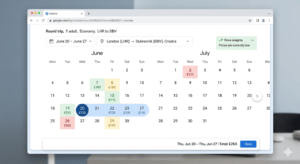
Budget travelers have a clear answer: April and October. Flights into Dubrovnik (DBV) or Ljubljana (LJU) drop significantly — on Google Flights, the calendar view shows late-October fares from London or New York running 30–50% below their August equivalents. Most major attractions are still open in both months.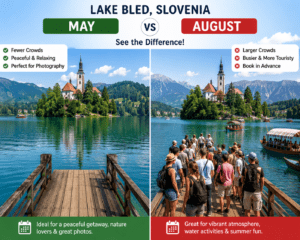
Practical Tools for Locking In the Right Dates
To pick the best specific dates for your Croatia and Slovenia trip, follow these steps:
- Open Google Flights’ calendar view and search DBV or LJU — check fare variation across your target month.
- Set price alerts on Booking.com for your first and last accommodation — these signal market demand before you commit.
- Check Plitvice Lakes’ official booking portal for timed-entry availability in your window.
- Verify Jadrolinija ferry schedules for your target islands — reduced winter schedules begin mid-October.
- Book the Eurail Croatia-Slovenia Pass if you’re combining rail travel across both countries.
Quick note: domestic flights within the region are almost never worth it. Slovenia’s rail network is genuinely good — Ljubljana to the Lesce-Bled bus connection takes under an hour — and coastal Croatia is better served by ferry and bus than by domestic air.
Shifting your trip by a single week at the boundary of peak season (the week of June 20 to June 27, or September 8 to September 14) can produce a meaningfully different experience and a noticeably lower accommodation bill. On Booking.com, filtered searches with price-sort make this comparison easy before you’ve committed to any dates.
https://total-croatia-news.com/news/htz-reports-on-successful-2023-tourist-season-in-croatia/
Voice Search Q&A
Q: What’s the best month to visit Croatia and Slovenia together? A: May and September are the best months for most combined itineraries. May offers lower prices and lush scenery; September gives warm swimming water and post-peak quiet. Both countries are fully operational in either month.
Q: How do I avoid the crowds in Dubrovnik? A: Visit before June 20 or after September 10. Within those dates, enter the old city before 8am or after 6pm — cruise passengers leave by early evening. Avoid arriving on Sundays in July and August, which is the peak charter-flight arrival day.
Q: Should I start my trip in Croatia or Slovenia? A: Start in Slovenia. Fly into Ljubljana, visit Lake Bled, then travel south into Croatia. This follows the natural geography, eases you into the trip before the coastal heat, and lets you fly home from Dubrovnik or Split — which have better international connections for return flights.
Q: Why does Lake Bled get so crowded in summer? A: Lake Bled is a small mountain lake with limited parking and one iconic viewpoint. Heavy Instagram visibility from around 2016 onwards pushed visitor numbers well beyond what the infrastructure was built to handle. September and October thin out noticeably — the autumn colours in October are a genuine reward for visiting then.
Q: When should I book flights to Croatia and Slovenia to get the best price? A: Book flights 4–6 months ahead for summer travel. For shoulder season in May or September, 2–3 months out is usually enough for flights, though top Dubrovnik old-town guesthouses fill faster. Use Google Flights’ calendar view to identify the cheapest week within your target month before committing.