
This guide covers Munich’s top attractions, neighborhoods, and day trips for leisure travelers spending 2–5 days in the city. It does NOT address extended stays, business travel logistics, or Oktoberfest-specific planning — that deserves its own deep dive.
What Are the Best Things to Do in Munich?
Things to do in Munich span everything from centuries-old royal architecture to lakeside surf spots inside a public park. The city sits in the heart of Bavaria and packs an unusually dense mix of world-class museums, beer culture, Alpine day trips, and green space into a remarkably walkable footprint.
According to the Munich Tourism Office (2024), the city welcomed approximately 7.9 million overnight visitors in 2023 — making it Germany’s second most-visited destination. And yet, most first-time visitors leave having seen only Marienplatz, the Hofbräuhaus, and maybe Nymphenburg Palace. That’s the equivalent of visiting New York and skipping everything above 34th Street.
Most people assume Munich is primarily an Oktoberfest city. The data — and the locals — say otherwise. The real Munich runs year-round, and its best moments happen in the gaps between the tourist checklist.
The Iconic Landmarks You Actually Shouldn’t Skip
Some things are on every list because they genuinely deserve to be.
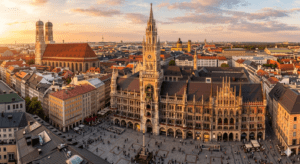
Marienplatz is Munich’s central square and the obvious starting point — not because it’s the most impressive thing in the city, but because everything radiates outward from it. The Neues Rathaus (New Town Hall) dominates the north side, and its Glockenspiel — a 43-bell carillon — performs daily at 11am, noon, and (May through October) 5pm. It’s touristy. It’s also legitimately worth watching once.
The Residenz is the one most visitors underestimate. This was the official royal palace of the Wittelsbach dynasty for over four centuries, and it contains 130 rooms open to the public, including one of the most intact Renaissance interiors in Germany. Entrance with the Munich City Tour Card drops to a meaningfully lower price — worth checking before you buy tickets at the door.
Nymphenburg Palace sits about 5 kilometers northwest of the center and most people either love it or feel vaguely underwhelmed. Here’s the thing: the palace interior is fine, but what’s actually worth your time is the formal gardens and the Amalienburg hunting lodge tucked inside them — a Rococo interior so ornate it feels almost hallucinatory. Skip the main palace if you’re pressed for time. Don’t skip the lodge.
The English Garden, Eisbach Wave, and Why Munich’s Parks Are Different
Munich has the English Garden. Stop there.
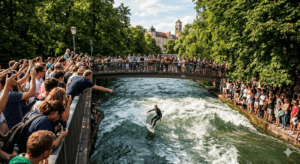
This isn’t a park in the way most people think of parks. The Englischer Garten covers roughly 910 acres — larger than Central Park in New York — and contains beer gardens, a Japanese tea house, a Chinese pagoda, a lake you can swim in, and a standing river wave where surfers ride year-round. That last part is not a typo. The Eisbach wave, near the Prinzregentenstraße bridge, produces a permanent surfable standing wave, and on any given afternoon you’ll find a rotating queue of wetsuit-clad locals waiting their turn.
Quick note: the wave is small and fast. It’s not a beginner situation — experienced surfers only, and even watching from the bridge is worth 20 minutes of your time.
The Hirschgarten beer garden, a short distance from Nymphenburg, is where locals actually drink on warm evenings. Seating for 8,000 people, beer by the Maß, and none of the tour group energy you’ll find at the Hofbräuhaus. Or maybe I should say it this way — if your goal is to understand Munich beer culture rather than perform it for Instagram, start here.
Museums Worth Blocking Out a Full Day For
Munich is quietly one of the great museum cities in Europe.
The Deutsches Museum is the world’s largest science and technology museum by floor space — according to its own documentation, it holds over 73,000 exhibited objects across 73 departments. I’ve seen conflicting visitor reviews on this — some find it overwhelming to the point of paralysis, others call it the best museum day of their lives. My read: go with a specific interest (aviation, astronomy, mining) rather than trying to cover everything, and you’ll leave satisfied.
The Pinakothek complex deserves its own afternoon. Three separate galleries — the Alte Pinakothek (Old Masters), Neue Pinakothek (19th-century), and Pinakothek der Moderne (modern and contemporary) — sit within a five-minute walk of each other in Maxvorstadt. Sundays admission drops to €1 per gallery. That is not a misprint.
BMW Welt and the BMW Museum sit together near the Olympic Park and serve slightly different audiences.
Quick Comparison — BMW Welt vs. BMW Museum
Option | Best For | Key Benefit | Limitation BMW Welt | Car enthusiasts, families | Free entry, futuristic architecture, live car deliveries | More showroom than museum BMW Museum | History and design buffs | Deep archive of vehicles and brand history, excellent curation | Paid entry, can feel dense Olympic Park | Outdoor visitors, architecture fans | 1972 Olympic site, rooftop walk, lake views | Limited if you’re not interested in sports history
Neighborhoods That Don’t Show Up on Most Lists
Look — if you’re spending more than two days in Munich, the neighborhoods are where the city actually lives.
Schwabing was Munich’s bohemian quarter in the early 20th century — Kandinsky lived here, and so did a young Lenin for a period. Today it’s gentrified but still walks the line between cafe culture and quiet residential streets better than most of the city center. The stretch along Leopoldstraße has good coffee and better bookshops.
Haidhausen, east of the Isar river, is the neighborhood that comes up most often when you ask Munich residents where they’d live if price were no object. The architecture is intact 19th-century row houses, the restaurant density is high and quality-driven, and it’s a ten-minute tram ride from Marienplatz. It’s not a tourist destination. That’s the point.
Maxvorstadt holds the university, the Pinakothek museums, and a concentration of independent galleries that most travel guides simply don’t mention.
Practical Logistics Most Guides Don’t Cover
This is the section that most Munich travel articles skip entirely — and it’s the one that actually determines whether your trip runs smoothly.
The MVV transit network covers the entire city and extends to the airport, Dachau, and several day-trip destinations. A single day ticket (Tageskarte) for the inner zones costs around €9.20 as of early 2026, but the Munich City Tour Card bundles unlimited transit with discounts at major attractions and often pays for itself by day two if you’re hitting museums.
To navigate Munich’s transit system efficiently, follow these steps:
- Download the MVV app before you land — it handles trip planning and ticket purchase
- Identify which ring zone your accommodation sits in — prices change by zone
- Validate your ticket at the machine before boarding, not after
- Use the S-Bahn (suburban rail) for airport and day trips, U-Bahn for city center movement
Book Dachau and Neuschwanstein tours in advance. Not because they’ll sell out weeks ahead, but because same-day availability on GetYourGuide and Viator is unpredictable in peak season (May through September), and entry to Neuschwanstein Castle specifically requires a timed ticket that goes fast.
Some travel writers argue that independent travel to Neuschwanstein is always better than a guided tour. That’s valid for confident German speakers who enjoy logistics. But if you’re managing multiple cities in one trip and don’t want to spend two hours figuring out the Füssen bus connection, a guided day tour from Munich is genuinely the more practical choice for most visitors.
Voice Search Q&A
Q: What’s the best time of year to visit Munich?
A: Late spring (May–June) and early fall (September, outside Oktoberfest weeks) offer the best weather and manageable crowds. Summer is beautiful but busy. Winter is cold but the Christmas markets run from late November through December.
Q: How do I get around Munich without a car?
A: The MVV network of U-Bahn, S-Bahn, trams, and buses covers the entire city efficiently. A day ticket for the inner zone handles most tourist movement. Walking is viable in the city center.
Q: Should I book Munich attractions in advance?
A: Yes for Neuschwanstein Castle (timed entry required), the Residenz (popular in peak season), and any day trips booked through GetYourGuide or Viator. Most city museums are fine without advance booking outside July–August.
Q: Why does the Eisbach wave have surfers in it?
A: The Eisbach channel creates a permanent standing wave where water flows over a submerged concrete ramp. It’s been a surfing spot since the 1970s and is one of Munich’s most photographed — and genuinely unexpected — sights.
Q: When should I avoid the Hofbräuhaus?
A: Weekends from 6pm onward pack it with tourists and bachelor parties. Weekday lunches are quieter and give you a more honest sense of the place — though locals largely drink elsewhere.