
Palermo Italy Guide 2026: What to Know Before You Go
Palermo is Sicily’s capital, and it’s nothing like the postcard version of Italy most travelers expect. Palermo, Italy refers to a port city on Sicily’s northern coast, blending Norman, Arab, and Baroque architecture with a street food culture built around markets that date back over a thousand years. It’s chaotic in places. It’s also one of the most rewarding city breaks in southern Europe right now.
Most guides to this city fall into two camps: bare attraction lists, or breathless travel-blogger prose that never answers the actual questions people search for. This one does both — the practical answer first, the reasoning after.
Is Palermo Worth Visiting? The Short Answer
Yes — and the data backs it up. Palermo is walkable, cheap compared to Venice or Florence, and the historic center concentrates most major sights within a compact area. According to Salt in Our Hair’s 2026 Sicily cost breakdown, a budget week in Palermo runs roughly €290–€450 per person, excluding flights. Mid-range travelers can expect €500–€1,400.
What most guides skip is the safety context. Palermo’s reputation still trails behind its reality by about two decades. The mafia’s operational grip on daily life has largely faded, and the No Mafia Memorial — a free museum walking visitors through that history — has become a genuine cultural attraction rather than a warning sign. Pickpocketing in crowded markets is the real risk, not organized crime touching tourists.
Here’s the thing: some travelers still steer around Palermo entirely, sticking to Taormina or Catania instead. That’s a reasonable call if you want a polished, resort-style Sicily trip. But if you want to understand the island rather than just photograph it, Palermo delivers something those cities don’t.
Quick Comparison
| Option | Best For | Key Benefit | Limitation |
|---|---|---|---|
| Palermo | Culture, history, food | Dense sights, cheap eats, real city life | Gritty edges, less beach access |
| Taormina | Relaxed, scenic breaks | Polished resort feel, coastal views | Pricier, touristy |
| Catania | Etna day trips | Central base for volcano tours | Less architectural variety |
Best Time to Visit Palermo
Palermo’s peak season runs June through August, when temperatures climb past 30°C and Mondello Beach gets packed. The better window sits outside that. April through June and September through October bring pleasant temperatures, thinner crowds, and comfortable conditions for walking the historic center’s cobblestones for hours at a stretch — which you will do, whether you plan to or not.
To plan your Palermo trip dates, follow these steps:
- Avoid late July and August if heat bothers you.
- Book shoulder-season flights (April–June or September–October).
- Check for local festivals, which shift crowd levels.
- Confirm Palatine Chapel hours — they’re limited on Sundays.
Winter works too, if you don’t mind a shorter daylight window and occasional rain. Fewer tourists, lower hotel prices. Simple trade-off.
How Many Days Do You Need in Palermo
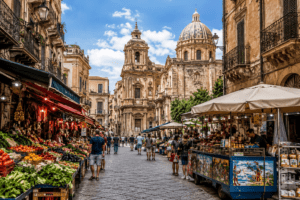
Three days covers the essentials comfortably. Two focused days handle the major sights — Palermo Cathedral, the Norman Palace and Palatine Chapel, Quattro Canti, and a proper wander through Ballarò or Capo market. The third day leaves room for Mondello Beach, thirty minutes outside the city, or simply sitting in a café doing nothing productive.
If you’ve got a fourth or fifth day, that’s when day trips make sense. Monreale’s cathedral, famous for its gold mosaics, sits just a short drive up the hill. Cefalù, a coastal town with a medieval center, works well as a half-day escape too.
One caveat worth stating plainly: this guide covers a first-time, general-interest visit. It does not address specialized itineraries like extended food-and-wine tours or mafia-history deep dives, which deserve their own planning entirely.
What to Eat, and Where the Markets Actually Deliver
Sicilian cuisine carries its own identity within Italian food, and Palermo is arguably its best showcase. Arancine, panelle, and sfincione dominate the street food scene, and locals will tell you — correctly — that two pizzas and water can still run under €15.
Ballarò and Capo remain the working markets, busiest and most authentic before noon. Vucciria, once Palermo’s most famous market, has shifted mostly toward evening bars and nightlife rather than fresh produce stalls. Some visitors expect the old Vucciria energy and leave disappointed. Go in expecting a different kind of scene, and it lands better.
Most people assume market food in a tourist-heavy old town means inflated prices and watered-down flavor. The data on this doesn’t fully support that — prices in Palermo’s central markets stay notably lower than comparable spots in Rome or Florence, even with tourist foot traffic factored in.
https://www.saltinourhair.com/italy/sicily-road-trip/
Where to Stay in Palermo
The historic center — around Quattro Canti, Via Maqueda, and the Kalsa district — puts you within walking distance of nearly everything. It’s noisier, especially near nightlife zones, but you won’t need transit.
For a quieter base with beach access, Mondello works, though you’ll commute into the city daily. In summer, that commute gets ugly around sunset, when traffic to and from the beach backs up hard.
Common Mistakes First-Time Visitors Make
Users who’ve tried planning Palermo trips without local input often report the same missteps. They underestimate walking distances on uneven cobblestone streets. They skip pre-booking Palatine Chapel tickets and hit long queues, even in late September. They assume Palermo has its own beach — it doesn’t. Mondello, thirty minutes out, is the closest option.
Renting a car in Palermo itself causes headaches too. Narrow one-way streets and limited parking make it more trouble than it’s worth inside the city. Save the rental for day trips outside the center, where trains and buses run less conveniently.
Voice Search Q&A
Q: What’s the best time to visit Palermo, Italy?
A: April through June or September through October, for mild weather and fewer crowds than peak summer.
Q: How many days should I spend in Palermo?
A: Three days covers the main sights comfortably, with a fourth or fifth for day trips like Monreale or Cefalù.
Q: Is Palermo safe for tourists?
A: Yes, generally. Stay alert in crowded markets for pickpocketing, but organized crime poses no real threat to visitors today.
Q: Should I rent a car in Palermo city center?
A: No — narrow streets and limited parking make it impractical. Rent only for day trips outside the city.
Q: Why does Palermo feel different from other Sicilian cities?
A: Its layered Norman, Arab, and Baroque history, plus a raw, working-market food culture, sets it apart from resort towns like Taormina.
The Bottom Line
Palermo rewards travelers willing to trade polish for texture. It’s not Taormina, and it’s not trying to be. If you want compact history, real street food, and a city that still feels lived-in rather than staged for tourists, this is where you spend your days. If you’re chasing beach-resort ease above everything else, look elsewhere on the island — and that’s a fair choice too.
This guide covers general first-time planning. It won’t help if you need mafia-history-focused itineraries, specialized food tours, or accessibility-specific routing — those need dedicated research beyond what’s here.