
Gujrati Food: A Dish-by-Dish Guide to What You’ll Actually Eat
Last updated: October 2026
Gujrati food refers to the vegetarian-leaning cuisine of Gujarat in western India, built on gram flour, lentils, yogurt and seasonal vegetables. Its signature trait is a balance of sweet, salty and spicy flavors, often inside a single dish.
You’ve probably tried dhokla once, you aren’t sure what else belongs on the plate, and you don’t want to order blind. Fair enough.
This guide covers mainstream vegetarian Gujarati dishes. It does NOT cover Kutchi seafood or Bohri cooking. It works best for first-time eaters and diaspora cooks, and it won’t help if you need measured recipes.
What Makes Gujrati Food Different From Other Indian Cuisines
Gujrati food stands apart because sweetness runs through savory cooking. Jaggery or sugar goes into dal, kadhi and vegetable dishes, then salt, green chili, ginger and lemon pull the flavor back. Gram flour, fermented batters and yogurt do most of the work, which keeps everyday meals plant-forward.
Sweet, then sharp. That’s the pattern.
Gujarat is mostly vegetarian, but not entirely. According to the Registrar General of India’s 2014 Sample Registration System Baseline Survey, about 61% of Gujaratis are vegetarian. Jain influence and merchant-community habits shaped that pattern, which is why many restaurants default to vegetarian menus.
Most people assume the state is almost fully vegetarian. The data says otherwise. Roughly 39% of residents eat non-vegetarian food, a larger share than in Punjab, Haryana or Rajasthan. I’ve seen conflicting data here: some sources put the vegetarian share at 60.95%, others at 61.8%. My read is that “roughly 61%” is the honest number.
https://censusindia.gov.in/nada/index.php/catalog/34787/download/38475/SRS_STAT_2014.pdf
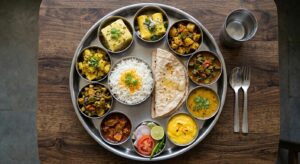
What’s Inside a Gujarati Thali
A Gujarati thali is a complete meal served on one plate: farsan, two or three vegetable dishes, dal or kadhi, rice, flatbread, pickle, salad and a sweet. According to the survey-backed picture above, most diners eat vegetarian, so thalis are built to feel full without meat. Each item has a job, whether crunchy, creamy, tangy or sweet.
To get the most from a thali, follow these steps:
- Start with farsan and chutneys.
- Pair each shaak with rotli or puri.
- Move to dal or kadhi with rice.
- Finish with chaas.
Quick note: some families eat the sweet first, others last. Neither is wrong, and a good restaurant won’t blink either way.
Many thali restaurants refill items on request, so the plate keeps changing while you eat. That’s the point. You aren’t picking one dish, you’re sampling a whole kitchen’s range in a single sitting, and you can’t really do that à la carte.
Gujrati Snacks and Breakfast Dishes Worth Ordering
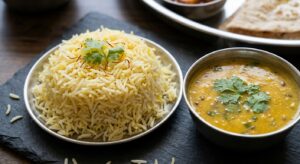
Farsan is the Gujarati word for savory snacks, and it’s the fastest way into the cuisine. Eaten at tea time or breakfast, it’s not a starter in the Western sense. Here’s what to look for:
- Dhokla: a steamed, fermented rice-and-lentil cake tempered with mustard seeds.
- Khaman: a softer, quicker gram-flour cousin, usually finished with a sweet-tangy tempering.
- Thepla: a spiced flatbread with fenugreek leaves that keeps well on trips.
- Fafda-jalebi: crisp gram-flour strips served with sweet jalebi, a classic weekend breakfast.
- Khandvi: thin gram-flour and yogurt sheets, rolled and tempered.
- Handvo: a baked, savory lentil-and-rice cake, often with bottle gourd.
Dhokla vs khaman: dhokla is better suited for a tangy, fermented bite because its rice-and-lentil batter rests overnight. Khaman works better when you want something soft and fast because gram-flour batter needs no long fermentation. The key difference is the batter.
Here’s the thing: dhokla is the least interesting item on that list. It’s famous because it packs and exports easily. Fafda and handvo show more technique, and if you only get one order, I’d pick either over dhokla. Or maybe I should say it this way: dhokla is the best entry point and the weakest representative.
How Gujrati Food Changes by Region
Gujarat isn’t one kitchen. Kathiawad (Saurashtra) cooking leans bold and garlicky, with bajra rotla and sev tamatar. Surat is known for undhiyu, a winter vegetable dish, and for a noticeably sweeter hand. Kutch gave the world dabeli, and the Ahmedabad area is where thali culture is easiest to find.
Some food writers argue the sweetness of Gujrati food is overstated and varies by household. That’s valid for Kathiawadi kitchens, which skew spicy. But if you’re eating in Ahmedabad or Surat, expect the sweetness to be real.
Quick Comparison
| Option | Best For | Key Benefit | Limitation |
|---|---|---|---|
| Thali | First-time diners | Many dishes in one sitting | Filling, hard to order light |
| Thepla | Travel and breakfast | Keeps well on trips | Mild without pickle or yogurt |
| Fafda-jalebi | Weekend breakfast | Iconic sweet-crunch pairing | Heavy and fried |
| Undhiyu | Winter meals | Deep seasonal flavor | Labor-intensive, seasonal |
[EXTERNAL LINK: Gujarat Tourism → regional food festivals and local cuisine]
Mistakes First-Timers Make With Gujrati Food
Users who’ve tried Gujarati restaurants often report the same three slips. They expect uniform sweetness, they order à la carte instead of a thali, and they skip the chaas. That last one hurts, because spiced buttermilk is what balances a rich plate.
What most guides skip is the timing. Farsan belongs to tea time, not the opening course of dinner. Order it that way and the meal makes more sense.
Look — if you’re cooking Gujrati food at home for the first time, start with thepla or kadhi. They forgive mistakes, and the ingredients are easy to find.
Quick Answers
Q: What’s the best Gujrati dish for beginners?
A: Thepla or dhokla. Both are mild, easy to find, and don’t require an acquired taste.
Q: How do I eat a Gujarati thali?
A: Start with farsan, pair vegetables with rotli, move to dal or kadhi with rice, and finish with chaas.
Q: Should I expect Gujrati food to be sweet?
A: Often, yes. Jaggery or sugar appears in dal and kadhi, though Kathiawadi cooking leans spicy instead.
Q: Why does Gujarati food taste sweet and sour together?
A: Cooks balance jaggery with lemon, tamarind or yogurt. The contrast is deliberate and makes simple vegetables taste layered.
Q: When should I eat undhiyu?
A: In winter, roughly December to February, when surti papdi and tender seasonal vegetables are at their best.