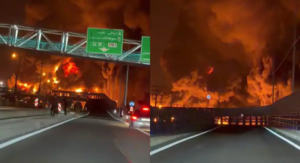
The humanitarian and environmental cost is only one aspect of Israel’s strikes, which military observers have said signals a terrifying escalation in the war. The other is economic.
A day after Israel’s attack oil prices – already under pressure because of the war and Iran’s blockade of the Strait of Hormuz, a key energy shipping channel – spiked sharply, crossing the US$100 per barrel red line for the first time in nearly four years.
On Monday a barrel of Brent crude, the international standard, was at US$107.97 after trading resumed on the Chicago Mercantile Exchange; it jumped 16.5 per cent from its Friday closing price of US$92.69. And West Texas Intermediate, the light, sweet crude produced in the US, was selling at $106.22 a barrel, about 16.9 per cent over last week’s close.
The US’ concern over Israel’s strike stems from a potential strategic misstep.
Attacks on oil and oil infrastructure could lead to Iranian citizens – even those who are now backing Donald Trump’s regime change operation – to rallying against the US and Israelis.
Equally significantly, it could also further drive up oil prices.
“The president doesn’t like the attack. He wants to save the oil. He doesn’t want to burn it. And it reminds people of higher gas prices,” a Trump adviser told Axios.
A furious Iran has warned that further strikes on oil infrastructure could prompt a similar response.
A spokesperson for Iran’s military said Tehran had not launched such attacks – i.e., energy infrastructure – so far but this could change and could drive prices to US$200 per barrel.
FAQs
- Who is more powerful, Israel or Iran?
Israel is generally considered more powerful technologically and militarily, with advanced air power and possible nuclear weapons, while Iran has larger manpower and ground forces. (The Times of India)
- Which countries are buying oil from Iran?
Major buyers of Iranian oil in recent years include China, India, Turkey, and Syria, with China being the largest importer.
- Who fired first, Israel or Iran?
In the current escalation, reports say Israel launched initial strikes on Iranian targets, after which Iran responded with missiles and drones.
- Who said Iran can’t have nuclear weapons?
Many Western leaders, especially U.S. presidents and Israeli leaders, including Donald Trump, have repeatedly said Iran must not obtain nuclear weapons.
- Who gave Iran nuclear power?
Iran’s nuclear program began in the 1950s with help from the United States under the “Atoms for Peace” program, and later Russia helped build the Bushehr nuclear power plant.

Pingback: How Long Does an Oil Change Take? Simple Guide for Better Car Maintenance 1