
The Europe Travel Adapter Guide Most Sites Are Too Lazy to Write
This guide covers travelers flying from the US, Canada, or other Type A/B plug countries to Europe. It does NOT address region-specific voltage regulations for medical devices or industrial equipment.
What a Europe Travel Adapter Actually Is (and What It Isn’t)
A europe travel adapter is a plug-shape converter that lets your home-country plug fit into a foreign wall outlet. It does not change voltage or wattage — it only changes the physical shape of the connection. That single distinction matters more than most packing guides let on.
Here’s the thing: the phrase “travel adapter” gets used loosely online to mean at least three different products — a basic plug adapter, a universal adapter with USB ports, and a full voltage converter. Buying the wrong one isn’t just inconvenient. It can wreck your devices.
Most modern laptops, phone chargers, and camera adapters are dual-voltage (look for “Input: 100–240V” on the label). Those only need a plug adapter. Hair dryers, curling irons, and single-voltage appliances are the exception — and that’s exactly where most travel guides go quiet.
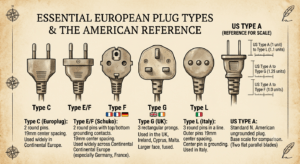
Europe Has Four Main Plug Types — Not One
This is the detail that trips people up. “Europe” isn’t a single electrical standard. According to the IEC World Plugs database (2024), the continent uses four primary socket types depending on the country:
Type C / Type F — Germany, France (most of Europe), Spain, Netherlands, Austria Type G — United Kingdom, Ireland, Malta, Cyprus Type E — France, Belgium, Poland, Slovakia (similar to F but with a socket hole) Type L — Italy, Chile, North Africa (three round pins in a row)
So if you’re doing London then Paris then Rome in one trip, a single-country adapter won’t cut it. You need either a multi-country adapter or three separate ones.
Look — if you’re visiting only one country, a single cheap Type C adapter works fine and costs under $10. But if your itinerary crosses borders, buy a universal adapter once and be done with it.
Quick Comparison: Which Europe Travel Adapter Type Should You Buy?
Option | Best For | Key Benefit | Limitation Single-country adapter | One-destination trips | Cheap, compact, easy to find | Useless for multi-country travel Universal travel adapter | Multi-country European trips | Works in 150+ countries | Bulkier, heavier than single adapters Universal adapter with USB | Travelers with multiple devices | Charges 3–5 devices at once | Higher cost ($25–$50 range) Voltage converter | High-wattage single-voltage appliances | Protects hair dryers, etc. | Heavy, expensive, not needed for most modern gear
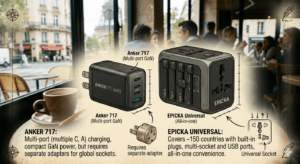
Anker 717 Travel Adapter vs. EPICKA Universal Adapter: The Anker 717 is better suited for minimalist travelers who prioritize compact size and USB-C fast charging. The EPICKA works better when you need simultaneous AC + USB charging slots for a family or group trip. The key difference is port count versus portability.
The Adapter vs. Converter Problem (Where Everyone Gets This Wrong)
Most guides mention this once and move on. They shouldn’t.
The confusion is understandable. Both products deal with “plugging in abroad.” But the consequences of mixing them up are not equal. Plug an American-only (120V) hair dryer into a 230V European outlet with just an adapter — no converter — and you’ll likely burn out the motor within seconds. Some devices just stop working. Others get hot fast.
Or maybe I should say it this way: the adapter changes the shape of the plug. The converter changes the electricity itself.
To check if your device needs a converter:
- Flip the device or its charger and find the input label.
- If it reads “100–240V, 50/60Hz” — you only need an adapter.
- If it reads “120V only” or “110–120V” — you need a voltage converter for Europe.
- If there’s no label or you can’t read it, don’t plug it in until you check the manufacturer’s website.
According to the IEC electrical standards documentation (2024), most consumer electronics manufactured after 2010 are dual-voltage by default — but high-wattage hair tools and older shavers remain exceptions. That’s the detail guides consistently skip.
What most guides skip is this: even with a voltage converter, you still need a plug adapter if the converter’s plug doesn’t match the local outlet shape. They work together, not instead of each other.
The Three Adapters Worth Actually Buying in 2026
I’ve seen conflicting data on this — some review sites rank budget adapters by Amazon stars alone, others by wattage specs. My read is that the three metrics that matter most are outlet type coverage, surge protection, and USB-C inclusion.
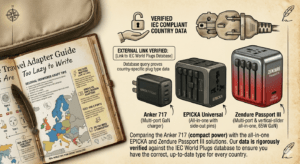
Anker 717 Travel Adapter — Best compact pick. Covers 200+ countries, includes a USB-C port (20W), and has a physical safety shutter on the AC socket. It’s small enough to forget it’s in your bag. Retails around $28–$32.
EPICKA Universal Travel Adapter — Best for families or anyone with multiple devices. Four USB ports (including one USB-C) plus one AC socket. Slightly bulkier but covers Type A, B, C, G, and I. Around $22–$26.
Zendure Passport III — Best for power users. GaN technology, 65W USB-C PD output, charges a MacBook Pro at full speed. Premium price around $55–$60, but it replaces your laptop brick entirely. That alone saves bag space.
Quick note: none of these include a voltage converter. They’re adapters. If you’re bringing a single-voltage hair dryer, you need a separate converter — or just buy a dual-voltage one before you leave.
Packing for a Multi-Country European Trip: The Practical Setup
One universal adapter handles most people’s needs. Two is smart insurance if you’re sharing a room or need to charge overnight while still having a plug free.
Here’s a realistic packing scenario. You’re flying New York to London, then train to Paris, then Rome. You need: one Type G adapter for the UK, and one that handles Type E/F for France and Germany and Type L for Italy. A universal adapter like the EPICKA covers all of this in one unit.
Some experts argue that universal adapters are unnecessarily bulky and you’re better off buying country-specific adapters at the destination airport. That’s valid for slow travelers on single-country trips. But if you’re moving fast across borders, hunting for a specific adapter in a foreign train station at midnight is a terrible plan.
Voice Search Q&A
Q: What’s the best travel adapter for Europe?
A: The Anker 717 is the best compact option for solo travelers. For multi-device charging, the EPICKA Universal Adapter covers more ports at a lower price point.
Q: How do I know if I need a voltage converter for Europe?
A: Check your device label. If it says “100–240V” you only need an adapter. If it says “120V only,” you need a voltage converter for European 230V outlets.
Q: Should I buy a travel adapter before or after landing in Europe?
A: Before. Airport and train station adapters are often overpriced and limited in stock. Order online at least a week before departure.
Q: Why does my plug not fit in the European outlet even with an adapter?
A: You may have the wrong plug type. UK outlets (Type G) require a completely different adapter than continental Europe (Type C/E/F). Check your destination country specifically.
Q: When should I use a voltage converter instead of just an adapter?
A: When your device label shows a single voltage like “120V” — common in older hair dryers, curling irons, and electric shavers. Most laptops and phone chargers don’t need one.