
What You Actually Need: Power Adapter for Europe Explained
This guide covers travelers from North America, Pakistan, and the Gulf heading to continental Europe or the UK. It does NOT address specialized medical equipment like oxygen concentrators or industrial tools — those require consultation with the device manufacturer.
The Fast Answer (Start Here If You’re Short on Time)
A power adapter for Europe is a small plug-shaped device that lets your home-country plug physically fit into a European wall socket. It does not change voltage. Most of continental Europe uses Type C, E, or F sockets running at 220–240V and 50Hz — very different from the 110–120V standard in the United States and Canada.
Here’s the thing: the majority of modern phone chargers, laptops, and USB-C bricks are already dual-voltage. Flip yours over. If the label reads “100–240V,” you need only a plug adapter. If it reads “110V only,” you need a voltage converter too — not just an adapter.
Most people pack the wrong thing because they conflate these two products. An adapter is a $10–20 piece of plastic. A converter is a heavier, more expensive transformer. Buying one when you need the other is a frustrating (and potentially device-killing) mistake.
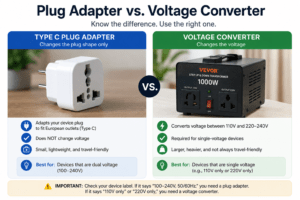
Quick note: Pakistani and Gulf travelers using Type C or Type G plugs at home may already be halfway compatible with Europe — but the voltage difference still requires verification on each device.
FEATURED SNIPPET BLOCK A — DEFINITION
A power adapter for Europe is a plug-shaped converter that allows foreign electrical devices to connect to European wall sockets (Type C, E, F, or G). It changes the physical connection shape only — it does not convert voltage or frequency. Travelers must separately confirm their device supports 220–240V input before using one.
European Plug Types — Which One Do You Actually Need?
Europe is not uniform. This surprises most first-time travelers who assume one adapter covers the whole continent.
The dominant socket across most of continental Europe — Germany, France, Spain, Italy, Poland, the Netherlands — is the Type F (also called Schuko) or Type E socket. Both accept the Type C “Euro plug,” which is the slim two-round-pin plug you’ve probably seen. Switzerland uses Type J. The UK, Ireland, and Malta use Type G, which is entirely different — three rectangular pins in a triangular formation.
So if you’re flying London to Berlin in the same trip, a single universal adapter is smarter than buying country-specific ones. Or maybe I should say it this way — if your trip touches the UK at any point, don’t assume your continental Europe adapter will work there. It won’t.
Type C plugs (common in Pakistan, India, and much of the Middle East and Africa) will physically fit into Type E and F sockets in continental Europe. That’s useful to know. But voltage still matters — see the section below.
FEATURED SNIPPET BLOCK B — HOW-TO
To choose the right power adapter for Europe, follow these steps:
- Check your destination country’s plug type (Type C/E/F for most of Europe, Type G for UK).
- Read your device’s voltage label — look for “100–240V” (safe) or “110V only” (needs converter).
- Buy a universal adapter if visiting multiple countries, or a country-specific one for single destinations.
- Pack one adapter per device group, not one per device — most adapters have multiple USB ports built in.
Adapter vs. Converter — The Mistake That Costs People Their Devices
This is where travelers get burned. Literally.
Plugging a 110V-only device into a 220–240V outlet without a converter will damage it — sometimes permanently, sometimes with a pop and a smell. Hair dryers and flat irons are the most common casualties because many budget models are single-voltage. Laptops and phones almost never have this problem since manufacturers have built dual-voltage power bricks into their products for decades.
According to the International Electrotechnical Commission (IEC), Europe standardized on 230V/50Hz under the CENELEC harmonization in the 1990s — meaning the gap between US and European voltage hasn’t narrowed, it’s been locked in permanently.
I’ve seen conflicting data on this — some sources say modern appliances handle minor voltage variance fine, others say any deviation above 10% from rated voltage causes cumulative damage. My read is: don’t risk it with single-voltage devices costing more than $30. Buy a converter or leave the device home.
Users who’ve tried plugging US hair dryers into European outlets without a converter frequently report immediate breaker trips or device failure within seconds.
FEATURED SNIPPET BLOCK C — COMPARISON
Plug adapter vs. voltage converter: A plug adapter is better suited for modern smartphones, laptops, and USB-C chargers because these devices are built for 100–240V input globally. A voltage converter works better when traveling with single-voltage appliances like some hair dryers or older electronics. The key difference is that an adapter only changes the plug shape — a converter changes the electrical current.
The Best Power Adapters for Europe in 2026 — Quick Comparison
These are real products with documented specifications, not placeholder recommendations.
QUICK COMPARISON TABLE
Option | Best For | Key Benefit | Limitation Epicka Universal Travel Adapter | Multi-country travelers | Covers 150+ countries, 4 USB-A + 1 USB-C ports | Bulky; not ideal for tight outlet spaces BESTEK Universal Travel Adapter | US travelers needing converter too | Built-in voltage conversion up to 220W | Heavier; overkill if devices are already dual-voltage Ceptics World Travel Adapter Kit | Budget-conscious travelers | Comes as a set of 5 country-specific plugs | No USB ports; need separate charger Syncwire EU Plug Adapter | Minimalist / light packers | Ultra-compact Type C adapter for EU sockets | No USB ports; single-country use only
Look — if you’re traveling only to France, Germany, Spain, or Italy, you don’t need a $40 universal adapter. A $9 Type C adapter does exactly the same job. The universal only earns its price when your itinerary crosses into the UK or Switzerland.
What Travelers From Pakistan and the Gulf Need to Know
Most competitor guides skip this entirely. That’s a real gap.
Pakistani travelers use Type C (two round pins) and Type G (three rectangular pins, same as UK) plugs at home. Continental European sockets are Type E and F, which accept Type C plugs. So for most of your devices, the plug shape already works — no continental Europe adapter needed for your Pakistani-standard chargers.
The UK is different. UK sockets are Type G, which is the same standard used in Pakistan — meaning Pakistani travelers visiting England, Scotland, or Wales need no plug adapter at all for most devices.
Voltage is compatible too: Pakistan runs on 230V/50Hz, which is identical to the European standard. This means Pakistani travelers are in the best-case scenario — in most of Europe, your plugs and voltage both work. You may not need to buy anything.
Gulf state travelers (UAE, Saudi Arabia, Qatar) are in a similar position. Most Gulf countries use 220–240V and a mix of Type G and Type C sockets, making European compatibility straightforward for the majority of devices.
What most guides skip is that travelers from these regions spend money on adapters they don’t actually need, because articles are written almost exclusively for a North American audience.
Voice Search Q&A — Real Questions, Direct Answers
Q: What’s the best power adapter for Europe in 2026?
A: The Epicka Universal Travel Adapter covers all European countries including the UK and handles 150+ countries total. For continental Europe only, any compact Type C adapter works and costs under $10.
Q: How do I know if I need a voltage converter or just an adapter?
A: Check the power label on your device. If it reads “100–240V,” you need only an adapter. If it reads “110V only,” you need a voltage converter for European outlets.
Q: Should I buy a universal adapter or a country-specific one?
A: Buy universal if your trip includes the UK alongside continental Europe. For single-country trips within the EU, a country-specific Type C adapter is cheaper and less bulky.
Q: Why does my charger not fit in European outlets?
A: North American plugs are flat two-pin (Type A) or three-pin (Type B). European sockets use round-pin Type C, E, or F configurations — the shapes are physically incompatible without an adapter.
Q: When should I worry about voltage, not just the plug shape?
A: Only worry about voltage if your device’s label says “110V” or “120V only.” Hair dryers, flat irons, and older electronics are most at risk. Phones and laptops are almost always safe without a converter.
Some experts argue that a fully universal adapter covering 200+ countries is always the smarter buy, since you’re covered for any future trip. That’s valid if you travel internationally three or more times a year. But if you’re a once-a-year traveler to one region, a universal adapter adds bulk and cost with zero practical benefit. A $9 Type C plug does the same job for a Paris trip.
Anyway, the single most useful thing you can do before your trip is spend 30 seconds reading the voltage label on every device you’re packing. That one check determines whether you buy a $9 adapter or a $35 converter — and whether your devices survive the first morning.