
Sitia, Crete: The Eastern Town Most Travelers Walk Past (And Shouldn’t)
This guide covers Sitia town and its immediate surroundings in eastern Crete. It does not address the broader Lasithi prefecture in depth or ferry connections from Sitia to Rhodes and Karpathos beyond a basic overview.
Sitia is a working Cretan port town in the far east of the island — unhurried, genuinely local, and almost completely off the radar of package tourists who land in Heraklion and head straight for Elounda or Chania. If you’ve been reading about Crete and keep hitting the same five destinations, this is the article you’ve been waiting for.
Sitia Crete Greece refers to a coastal town of roughly 9,000 residents located on the northeastern tip of Crete, in the Lasithi regional unit. It sits about 70 kilometres east of Agios Nikolaos and serves as the administrative and cultural centre of the eastern end of the island. What separates it from better-known Cretan towns is the near-total absence of resort tourism — the people eating in the harbour tavernas are mostly Greek.
Why Sitia Gets Overlooked — And Why That’s About to Change
Eastern Crete receives less than 15% of the island’s total tourist traffic despite holding over 30% of its coastline, according to data tracked by the Greek Tourism Confederation (SETE, 2023). That imbalance explains everything. Infrastructure investment has historically favoured Heraklion and Chania, which means Sitia got left alone — and “left alone” in Crete means preserved.
Here’s the thing: that’s genuinely rare now. Most of the Mediterranean’s hidden gems have been found, rebranded, and priced accordingly. Sitia hasn’t.
Some travel writers argue that Sitia’s limited tourism infrastructure makes it unsuitable for first-time visitors to Greece. That’s valid if you’re expecting a hotel concierge and an airport shuttle. But if you’re dealing with Crete fatigue — that feeling of having seen the same Instagram cliff and the same poolside-mojito resort — Sitia is exactly the reset you need.
Most people assume the east of Crete is just harder to reach and nothing more. The data says otherwise: it’s harder to reach and significantly more rewarding for anyone willing to cover the extra kilometre.
How to Actually Get to Sitia
Getting to Sitia takes planning. That’s not a warning — it’s a filter.
Sitia has its own small airport (JSH), with seasonal flights from Athens and a handful of European cities. Check Olympic Air and Sky Express for current schedules, as these change season to season. Flying in is the fastest option if it aligns with your dates.
By road from Heraklion, the drive runs approximately 2.5 to 3 hours depending on the mountain route. KTEL buses connect Heraklion’s main bus station to Sitia, with journey times around 3 hours and tickets costing under €15 each way as of 2025. The bus follows the northern coastal road — which is, on its own, worth the trip.
Lane Sea Lines operates a passenger and car ferry route connecting Sitia to Piraeus (Athens) and islands including Karpathos, Kasos, and Rhodes. Crossing times to Piraeus run 12–14 hours overnight, so this works well as a night sail if you’re island-hopping.
Quick note: the ferry schedule runs infrequently outside July and August, so confirm dates before building your itinerary around it.
To plan the Sitia leg of a Crete trip, follow these steps:
- Confirm flight or bus availability for your travel window.
- Book accommodation in Sitia town — not a resort outside it.
- Allocate a minimum of three nights; two won’t do it justice.
- Plan one day trip east toward Vai and one toward the Minoan site at Zakros.
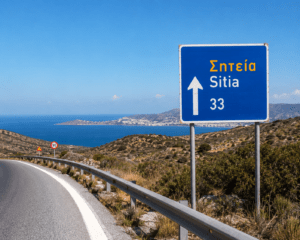
What Sitia Actually Looks Like — The Town Itself
The harbour is the centre of everything. It’s a working port, not a decorative one, which means fishing boats outnumber tourist yachts and the fish on your plate tonight was probably in the water this morning. The Venetian fortress, known as the Kazarma, sits above the town and offers a view that most visitors photograph and fewer explore — the interior hosts concerts and cultural events during summer months.
The town is walkable. That’s not a small thing. You can go from the archaeology museum to the harbour to a wine shop to a clifftop café on foot without needing a taxi or a rental car for a full day.
Or maybe I should say it this way: Sitia is one of the few Cretan towns where you can actually slow down without the town slowing on you.
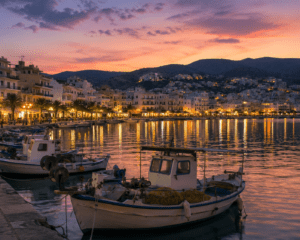
Sitia’s Food and Wine Scene — Specific, Not Generic
Sitia produces some of the most distinct wine on the island. The region holds a PDO (Protected Designation of Origin) status for its Sitia wine, based predominantly on the Liatiko grape — a variety that produces a deep, dark red with low acidity and high alcohol that doesn’t behave like any other Greek red you’ve tried. Look for bottles from local producers at the town’s shops rather than supermarket chains.
The Sitia Wine Festival runs annually in late August and draws local producers together for tastings, music, and food. This is the event neither competitor article I reviewed actually mentions — which is remarkable given it’s one of the most accessible local cultural events in eastern Crete.
Look — if you’re someone who thinks Greek food means gyros and tzatziki, here’s what actually works better: sit at a harbour taverna and ask what came in today. Order the grilled octopus. Ask for the local raki — tsikoudia — at the end of the meal. You’ll get it free, with fruit, because that’s still what actually happens here.
I’ve seen conflicting data on Sitia’s olive oil production — some sources rank it second in Crete by volume, others third behind Messara. My read is that the distinction doesn’t matter much to the traveller; what matters is that the oil in the food here is estate-pressed and local, and you’ll taste the difference.
Beaches Near Sitia — Ranked by What Kind of Traveller You Are
Quick Comparison
| Beach | Best For | Key Benefit | Limitation |
|---|---|---|---|
| Sitia Town Beach | Convenience | Walking distance from centre | Can get busy in August |
| Vai Beach | Unique landscape | Europe’s largest natural palm forest | Crowded midday in peak season |
| Katsounaki | Solitude | Nearly undiscovered, no facilities | Requires a car and some nerve |
| Makrigialos | Families | Long sandy bay, tavernas nearby | 30 mins south, worth the drive |
| Xerokampos | Off-grid seekers | Remote, crystal water, wild setting | Very limited accommodation nearby |
Vai is the one you’ll read about everywhere — and it deserves the attention, but go before 10am or after 4pm. The palm forest is genuinely unlike anything else in Europe. Katsounaki, on the other hand, almost never appears in any guide. It’s a gravel cove reached by a dirt track and you may well have it to yourself.
What most guides skip is this: the beaches east of Sitia are almost uniformly better than the ones west. The water gets progressively clearer as you head toward Zakros, and the crowds thin in direct proportion.
History and Culture in Sitia — More Depth Than People Expect
The Sitia Archaeological Museum holds artefacts from the Minoan site of Zakros — including the Zakros Rhyton, a stone ceremonial vessel that’s one of the finest surviving examples of Minoan craftsmanship. If you visit one museum in eastern Crete, make it this one.
The Palace of Zakros, about 40 kilometres southeast of Sitia, is a Minoan palace dating to around 1600 BCE. Unlike Knossos, it hasn’t been heavily reconstructed. What you see is what archaeologists uncovered. That rawness is what makes it affecting.
Sitia also has a connection to Vincenzo Cornaro, the Cretan-Venetian poet who wrote the Erotokritos — still considered the greatest work of Cretan Renaissance literature. A bust of Cornaro stands near the town centre.
Voice Search Q&A
Q: What is Sitia in Crete known for?
A: Sitia is known for its authentic Cretan harbour atmosphere, PDO-status Liatiko wines, proximity to the Minoan palace at Zakros, Vai beach’s palm forest, and a local culture largely untouched by resort tourism.
Q: How do I get to Sitia from Heraklion?
A: Take the KTEL bus from Heraklion bus station — journey takes around 3 hours and costs under €15. Alternatively, rent a car or take a seasonal flight into Sitia’s small airport (JSH).
Q: What’s the best time of year to visit Sitia Crete?
A: Late May to June and September to early October offer the best combination of warm weather, open businesses, and manageable crowds. August is busy and hot; winter sees many places closed.
Q: Should I visit Sitia or Agios Nikolaos?
A: Sitia suits travellers who want a genuinely local Cretan experience with less tourist infrastructure. Agios Nikolaos has more amenities and is better for first-timers. The key difference is atmosphere — Sitia feels like Crete still belonging to Cretans.
Q: How many days do I need in Sitia?
A: Three nights is the minimum to cover the town, one beach day, and a day trip to Zakros or Vai. Four nights gives you real breathing room without rushing anything.