
Does Molasses Go Bad? Here’s the Real Shelf Life
Molasses does not go bad the way milk or bread does. An unopened bottle can sit in the pantry for well over a decade, and an opened one typically stays good for 18 months to two years past its best-by date if it’s stored properly. That’s the short answer. The longer answer explains why, and how to tell when a jar has actually crossed the line from “just older” to “actually spoiled.”
If you’re staring at a dusty jar right now trying to decide whether to bake with it, keep reading. This won’t take long.
Does Molasses Expire? The Straight Answer
Molasses is a shelf-stable pantry staple that resists spoilage because of its extremely high sugar concentration. Unopened, it can last 10+ years without meaningful quality loss. Once opened, most manufacturers print an 18-month best-by window, though many home cooks report using molasses well past that mark with no issues at all.
That best-by date isn’t a safety cutoff. It’s a quality estimate. Molasses is one of those items that manufacturers date conservatively, mostly to protect flavor consistency rather than to warn you off using it.
Here’s the thing: molasses behaves more like honey than like fresh produce. Both are dense, low-moisture, high-sugar substances that microorganisms simply can’t thrive in. That’s not a coincidence — it’s chemistry, and it’s worth understanding if you want to stop worrying every time you open an old jar.
Why Molasses Barely Spoils — The Actual Science
Most people assume anything made of sugar should spoil fast, since sugar feeds bacteria. The data says otherwise. What actually determines spoilage isn’t sugar content — it’s available water.
Bacteria, yeast, and mold all need free water molecules to grow. Sugar is a humectant, meaning it binds water tightly and leaves almost none available for microbes to use. Molasses is so densely saturated with sugar that it creates what food scientists call a low water activity environment — inhospitable to nearly everything that causes typical food spoilage.
This is the same principle that lets granulated sugar and honey sit in a cabinet indefinitely. What most guides skip is that this protection is strongest at the surface and weakest wherever outside moisture gets introduced — a wet spoon, steam from a nearby pot, a lid that didn’t seal all the way.
Quick comparison, since people often mix these two up:
Quick Comparison
| Option | Best For | Key Benefit | Limitation |
|---|---|---|---|
| Unopened molasses | Long-term pantry storage | Lasts 10+ years unaffected | Flavor still slowly mellows over time |
| Opened molasses | Regular baking use | Stays usable 18–24+ months | Needs a clean spoon and tight lid |
| Refrigerated molasses | Not recommended | N/A | Thickens and hardens, harder to pour |
Unopened jars are better suited to long-haul storage since nothing has broken the seal. Opened jars work fine for everyday baking as long as contamination stays out. The key difference comes down to exposure, not age.
How to Store Molasses So It Actually Lasts
To keep molasses at peak quality for as long as possible, follow these steps:
- Store it in a cool, dark pantry away from the stove.
- Keep the lid tightly sealed after every use.
- Always use a clean, dry spoon.
- Skip the fridge — it thickens molasses and makes it hard to pour.
- Wipe the rim before resealing to prevent stickiness and buildup.
Refrigeration feels like the safe instinct, but it works against you here. Cold temperatures thicken molasses into something closer to tar, and that thickness doesn’t reverse cleanly once you bring it back to room temperature. Most producers, including Grandma’s Molasses and Brer Rabbit, print pantry-storage instructions right on the label for exactly this reason.
Quick note: if your kitchen runs hot and humid — say, near a stove or a sunny window — consider a lower cabinet instead. Heat speeds up the slow darkening and thickening that happens naturally over years.
Signs Molasses Has Actually Gone Bad
Real spoilage in molasses is rare, but it does happen. According to food-safety guidance from university extension programs, high-sugar syrups can still spoil if moisture or contaminants breach the surface, even though the base product resists microbial growth extremely well.
Toss the jar if you notice:
- Visible mold, especially fuzzy spots on the surface
- A sour, fermented, or “off” smell that wasn’t there before
- Active bubbling or fizzing in the jar
- Any sign of insects or debris inside
Darkening, thickening, or mild crystallization are not red flags. They’re just age. Molasses genuinely doesn’t “go bad” the way most foods do — it ages, slowly and mostly cosmetically, and the flavor shift is often the only real consequence.
I’ve seen some sources claim molasses lasts indefinitely with zero quality change, and others say it noticeably degrades after a year or two. My read: both are partly right. Safety-wise, it’s close to indefinite. Flavor-wise, older molasses does flatten or intensify depending on how much moisture has evaporated, so “still safe” and “still tastes the same” aren’t quite the same claim.
What This Guide Covers — and What It Doesn’t
This guide covers shelf-stable pantry storage of standard grocery-store molasses — light, dark, and blackstrap varieties like Crosby’s or Grandma’s. It doesn’t address commercially canned or specialty fermented molasses products, which can carry different storage instructions, and it isn’t a substitute for checking your specific product’s label if something looks unusual.
If you’re baking something time-sensitive, like a holiday gingerbread recipe, and your jar passes the smell-and-look test, it’s almost certainly fine to use.
Common Questions About Molasses Shelf Life
Q: How long does molasses last after opening?
A: Typically 18 to 24 months at peak quality, though it often stays usable well beyond that if stored properly.
Q: Should I refrigerate molasses?
A: No. Refrigeration thickens molasses and makes it harder to pour without improving shelf life.
Q: Why does molasses crystallize over time?
A: Sugar concentration increases as moisture slowly evaporates, causing mild crystallization — a quality change, not spoilage.
Q: What’s the best way to tell if molasses is still good?
A: Check for mold, a sour smell, or bubbling. If none are present, it’s safe to use.
Q: When should I throw molasses away?
A: Toss it only if you see mold, smell fermentation, notice bubbling, or spot insect contamination.
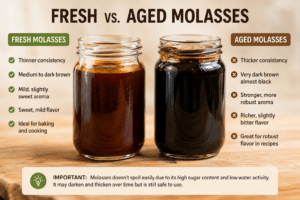
Molasses is one of the rare pantry items where “old” doesn’t mean “unsafe.” Treat it like honey — sealed tight, kept dry, stored somewhere dark — and one jar can realistically outlast several baking seasons.