
Does Icing Sugar Expire? What Lumps, Dates and Smells Really Mean
Short answer: no. Icing sugar doesn’t rot the way bread or milk does, so a bag that’s two years past its date is usually still usable. What can ruin it is moisture, strong smells, and pests. This guide shows you how to spot each one in about a minute.
Can icing sugar go bad refers to whether powdered sugar becomes unsafe or unusable over time. Dry icing sugar doesn’t support bacteria, so only moisture, mold, insects, or absorbed odors make it unfit to use.
This works best for ordinary store-bought icing sugar kept in a kitchen cupboard. It won’t help if the sugar got soaked, because wet sugar needs a closer look.
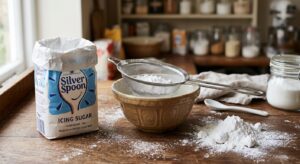
Does Icing Sugar Go Bad? What the Manufacturers Say
Icing sugar going bad depends on how it’s stored, not how old it is. According to Domino Sugar’s 2024 shelf life guidelines, its granulated and powdered sugars can be used indefinitely. C&H Sugar suggests using powdered sugar within two years for best quality, a window that reflects clumping, not safety.
Most people assume the printed date is a safety cutoff — the data says otherwise. The two-year figure tracks how well the sugar resists caking, not whether it’s safe.
I’ve seen conflicting data — some sources treat the two-year mark as a safety limit, others call it purely a texture guideline. My read is texture, because dry sugar gives bacteria nothing to grow on. So ignore the best-before date and trust your eyes and nose. Some bakers will push back, since a printed date feels like a rule. But a sieve and a sniff test tell you more than a stamp ever will.
Trust the sugar, not the stamp.
How to Tell If Icing Sugar Has Actually Gone Bad
Checking whether icing sugar has gone bad comes down to four signs: visible mold, insects, wet dense clumps, and strong off smells. According to C&H Sugar, powdered sugar also picks up nearby odors even through its bag. Soft, dry lumps alone aren’t a reason to throw it out.
- Mold: fuzzy growth of any color, a sign that liquid got into the jar. Discard all of it.
- Insects: ants, moths, beetles, or webbing. Bin the sugar and wipe down the shelf.
- Wet, dense clumps: hard, damp lumps that won’t crumble, especially with a musty smell or discoloration.
- Strong off smell: if a pinch dissolved in warm water tastes of onion, spice, or cleaner, replace it.
Soft lumps are the sign people misread most.
Lumpy icing sugar is a texture problem, not a spoilage problem. Fine sugar particles and the cornstarch mixed in absorb humidity from the air, then bond into clumps as they dry. The sugar itself is chemically unchanged, so dry lumps carry no safety risk, and sifting fixes the texture.
What most guides skip is that icing sugar soaks up smells, even through its bag. Users who’ve stored it beside onions, spices, or coffee often report frosting with a faint savory edge.
Some experts argue any sugar that’s ever been damp belongs in the bin, and that’s valid for wet clumps, discoloration, or a musty smell. But if you’re dealing with soft, dry lumps, the sugar itself hasn’t changed. If it’s dry and it doesn’t smell, you’re good to bake.
How to Fix Lumpy Icing Sugar in Minutes
Here’s the thing: every fix comes down to two moves, either separating the particles or removing the moisture that glues them together. Start with the gentlest option.
To fix lumpy icing sugar, follow these steps:
- Break soft lumps apart with a fork.
- Press the sugar through a fine sieve.
- Dry hard clumps on a tray in a very low oven, then cool.
- Sift again before measuring.
For the oven step, use the lowest setting, around 150–200°F (65–90°C), with the door slightly open for 10–15 minutes.
Sifting vs oven-drying: Sifting is better suited for soft, dry lumps because it takes seconds and changes nothing. Oven-drying works better when clumps are hard or slightly damp. The key difference is that sifting only separates particles, while drying removes the moisture holding them together.
Quick Comparison
| Option | Best For | Key Benefit | Limitation |
|---|---|---|---|
| Fork | Minor soft lumps | No extra tools needed | Leaves small lumps in frosting |
| Fine sieve | Frosting and dusting | Smooth, even powder | Slow for large batches |
| Food processor | Heavily clumped bulk bags | Fast on big quantities | Needs sifting afterward |
| Low-oven drying | Hard, stubborn clumps | Removes trapped moisture | Slow; must cool fully first |
If the bag is beyond saving, blend 1 cup of granulated sugar with 1 tablespoon of cornstarch for about five minutes, then sift it.
How to Store Icing Sugar, Especially in Humid Weather
Storage decides whether icing sugar stays silky for years or turns into a brick. The original bag is the weak point, since folded paper lets in humidity and odors.
- Airtight jar: glass or ceramic with a rubber gasket, such as a Kilner clip-top jar.
- Cool, dry cupboard: away from the stove, kettle, and anything strongly scented.
- Dry spoon only: a damp spoon starts the clumping cycle again.

Skip the fridge and the freezer. Domino Sugar’s guidelines say not to refrigerate or freeze it. Condensation forms when the container returns to room temperature, and that moisture is exactly what causes lumps. Users who’ve tried the fridge often report worse clumping, not better.
Look — if you’re baking in a humid kitchen with a half-used bag, here’s what actually works: decant it into a sealed jar today and keep it off the counter beside the kettle.
Think of icing sugar as a dry sponge for smells. Or maybe I should say it this way: it’s a sponge for anything in the air, smells and moisture both.
Quick Answers on Icing Sugar Shelf Life
Q: What’s the best way to store icing sugar long term?
A: Use an airtight glass or ceramic jar with a rubber seal, and keep it in a cool, dry cupboard away from strong-smelling foods, the stove, and cleaning products.
Q: How do I get lumps out of icing sugar?
A: Sift it through a fine sieve. For hard clumps, dry them on a tray in a very low oven, cool them completely, and sift again.
Q: Should I keep icing sugar in the fridge?
A: No. Domino Sugar and C&H Sugar both advise against it, because condensation forms when the container warms up, and that moisture brings back the lumps you were trying to avoid.
Q: Why does my icing sugar smell strange?
A: It soaks up nearby odors, even through the bag. Onions, spices, coffee, and cleaning products are the usual culprits, so store it apart from them.
Q: When should I throw icing sugar away?
A: Bin it if you see mold, insects, or wet dense clumps with an off smell, or if a pinch dissolved in water tastes of something other than sugar.
Should You Keep It or Bin It?
Icing sugar ranks among the safest things in your pantry. Check for mold, insects, wet clumps, and off smells; if none show up, sift it and bake.
This guide covers plain white icing sugar. It does NOT address flavored, colored, or ready-made frosting mixes, because those contain other ingredients and follow their own storage rules, so check the label. A bag that’s been soaked or smells off? Replace it. It costs very little.