
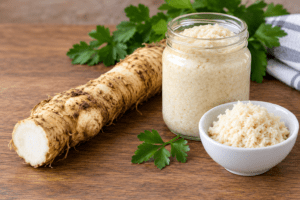
Does horseradish go bad? Yes, but the more common problem is losing its heat, not becoming unsafe. Horseradish’s pungency comes from a compound that forms the moment the root is cut, and that compound breaks down over weeks — even in the fridge. Whole root lasts about 3 months refrigerated, fresh grated horseradish is best within 1 to 2 months, and jarred prepared horseradish, thanks to its vinegar content, lasts considerably longer.
Quick Comparison
| Form | Refrigerator | Freezer |
|---|---|---|
| Whole root | ~3 months | Not recommended (texture suffers) |
| Freshly grated or homemade relish | 1–2 months before it goes mild | ~6 months |
| Jarred prepared, opened | 4–6 months, some brands longer | Not recommended |
| Jarred prepared, unopened | Check the label | Not recommended |
Why Horseradish Loses Its Kick
Here’s the thing: horseradish doesn’t store heat the way a chili pepper does. Capsaicin sits in the pepper ready to go. Horseradish makes its heat on demand.
The intact root holds two things apart — a compound called sinigrin and an enzyme called myrosinase. Grating or cutting the root breaks the cell walls and lets them mix. That reaction produces allyl isothiocyanate (AITC), the volatile oil behind horseradish’s sinus-clearing bite. It’s the same basic chemistry that gives mustard and wasabi their heat, since all three are related plants.
AITC doesn’t last. It evaporates and breaks down chemically, sealed container or not. Freshly grated horseradish is always hotter than horseradish that’s been sitting a few days, and the drop-off keeps going for weeks. Vinegar interrupts this: adding it once you hit the heat level you want stops the sinigrin-myrosinase reaction and locks that flavor in. That’s why recipes tell you to grate first and add vinegar last.
According to Oregon State University Extension guidance on preserving horseradish, a whole root stored properly keeps its best flavor for around 3 months. Fresh grated horseradish, by contrast, can lose meaningful pungency within just 1 to 2 months even refrigerated — which is why the standard advice is to grate small batches rather than a big one meant to last.
Quick note: this is also why you can’t home-can horseradish sauce for pantry storage. Canning-level heat destroys the same volatile compounds that make it worth eating, so it has to stay refrigerated or frozen either way.
How Long Horseradish Actually Lasts, by Form
Whole root. The unpeeled root protects itself — sinigrin and myrosinase stay separated until you cut into it. Wrap it loosely in a damp paper towel or keep it in a perforated bag in the crisper drawer. About 3 months is realistic before flavor noticeably fades.
Freshly grated. Grate only what you’ll use in a month or two. Stir in a splash of vinegar once it’s as hot as you want, then refrigerate it airtight. Freezing extends this to roughly 6 months — texture changes a bit, but the heat holds up reasonably well, especially portioned into an ice cube tray.
Prepared, jarred horseradish. Once opened, keep it sealed and refrigerated. Most brands are good for 4 to 6 months for peak flavor, though it typically stays safe to eat somewhat longer than that as it fades. Check the label before you assume it’s shelf-stable — some jars sit safely in the pantry unopened, others are sold from the refrigerated case and expect refrigeration from day one.
https://lifetoolkit.tech/genoa-salami/
Signs Horseradish Has Actually Gone Bad
Losing heat is a quality issue. Mold, sliminess, or a sour, off smell — that’s real spoilage, and any of those means toss it.
Discoloration trips people up more than it should. Freshly grated horseradish yellows or turns light tan within a day or so, just from oxidation — the same harmless browning you see on a cut apple. On its own, that’s not a spoilage sign.
What actually matters: discoloration paired with sliminess, mold, or an off smell, or a shift toward gray or greenish tones instead of light tan. If the color’s changed but it still smells sharp and clean, it’s fine — just milder than fresh.
The Real Safety Risk (It’s Not What Most People Think)
A common claim online is that old horseradish grows bacteria that causes botulism. That’s backward. Properly refrigerated horseradish — whole root, fresh grated, or vinegar-based prepared — isn’t a meaningful botulism risk on its own. Vinegar-based prepared horseradish is acidic enough to inhibit the bacteria in question.
What most guides skip is where the actual risk lives: homemade horseradish covered in oil and left unrefrigerated. Horseradish is a low-acid root grown in soil, the same general category as garlic, and according to Penn State Extension’s guidance on infused oils, that makes it a possible source of Clostridium botulinum spores. Submerged in oil at room temperature, the mixture becomes low-acid and oxygen-free — exactly the environment those spores need to germinate and produce toxin. It’s the same mechanism behind documented garlic-in-oil botulism cases.
I’ve seen some sources frame any “old” horseradish as risky, full stop. My read, based on how the chemistry actually works, is that the risk is narrow and specific — it’s about oil, not age. Commercially prepared horseradish is formulated to be safe, and grated horseradish mixed with vinegar and refrigerated is standard, low-risk practice. The one thing to actually avoid is leaving a homemade oil-based horseradish mix unrefrigerated.
This guide covers root, grated, and jarred horseradish stored the normal way. It doesn’t cover commercial food-safety testing standards for manufacturers — that’s a different topic.
FAQ
Q: How long does horseradish last in the fridge?
A: Whole root, about 3 months. Fresh grated, 1 to 2 months before it goes mild. Jarred prepared, 4 to 6 months once opened.
Q: Does horseradish need to be refrigerated?
A: Whole root and fresh grated, yes, always. Jarred varies by brand — check the label for refrigeration instructions.
Q: Can old horseradish give you food poisoning?
A: Properly refrigerated horseradish that’s just gone mild isn’t a poisoning risk. The real danger is homemade horseradish left unrefrigerated in oil.
Q: Why does horseradish lose its heat over time?
A: Its heat comes from allyl isothiocyanate, a compound formed when the root is cut. It’s chemically unstable and breaks down over weeks, fridge or not.
Q: Can you freeze horseradish?
A: Yes. Grated horseradish freezes for about 6 months, best mixed with a little vinegar first. Whole roots hold up better refrigerated than frozen.