
How to Remove Avocado Stains Before They Turn Brown
Avocado stain removal means treating a fat layer and a pigment layer separately, in that order. Skip the pigment step and the stain looks gone when wet, then reappears as an olive-brown ghost once the fabric dries.
Here’s the short version, then we’ll go deep on every surface you’re likely to be dealing with.
Quick Answer: Scrape off the excess avocado from the outside in. Apply dish soap or an enzyme stain remover dry — no water yet — and let it sit 5-10 minutes. Rinse cold from the back of the fabric. If green or brown pigment remains, treat with oxygen bleach (colors) or hydrogen peroxide (whites) for 30-60 minutes, then launder cold.
Why Avocado Stains Behave Differently Than Other Food Stains
Most food stains just sit there. Avocado doesn’t. It contains an enzyme called polyphenol oxidase, or PPO, which starts converting the fruit’s pigments into darker, more stubborn compounds within seconds of hitting oxygen. It’s the same reaction that browns a cut avocado on your kitchen counter.
That means the stain on your shirt right now is chemically different from the stain that will be there in five minutes. Speed genuinely matters here in a way it doesn’t for, say, a ketchup spill.
There’s a second complication: fat. Avocado is roughly 15-20% oleic acid, a fat that soaks into fibers fast and traps pigment against the fabric. Add water too early and you’re not rinsing anything out — you’re pushing oil deeper into the weave while diluting whatever cleaner you put on next.
So there are really two problems stacked on top of each other. One is oily, one is enzymatic. Treating only one is why the stain always seems to come back.
According to the USDA Economic Research Service, U.S. per-capita avocado consumption climbed from around 4 pounds in 2001 to more than 8 pounds by the early 2020s. More avocado on more plates means more avocado on more shirts, car seats, and high chairs — which is probably why you’re reading this.
The Fat-First, Pigment-Second Method (Works on Almost Any Fabric)
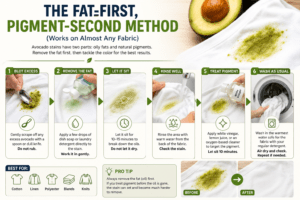
To remove an avocado stain, follow these steps:
- Scrape excess avocado outward-in with a spoon.
- Apply dish soap or enzyme remover dry.
- Let it sit 5-10 minutes, then rinse cold.
- Treat leftover pigment with oxygen bleach or peroxide.
- Launder cold and check before drying.
Don’t rub. Rubbing spreads solid avocado across clean fibers instead of lifting it off, and it’s most people’s first instinct — which is exactly the problem.
Once the fat is scraped away, apply liquid dish soap straight onto the dry stain and work it in gently with a fingertip, moving from the outside in. Give it five to ten minutes. The soap’s surfactants break the bond between fat and fiber, which has to happen before anything else works. Rinse from the back of the garment with cold water so you’re pushing the stain out, not through.
An enzyme-based stain remover does this more thoroughly than dish soap alone, because it pairs lipase (for fat) with protease (for the plant proteins in avocado flesh). If you’ve got one on hand, use it instead of soap for anything that’s had more than a couple minutes to set.
Oxygen bleach vs. hydrogen peroxide: Oxygen bleach works better on colored fabric because it won’t strip dye the way peroxide can. Hydrogen peroxide works faster and more aggressively on whites. The key difference is that peroxide is stronger but color-unsafe, while oxygen bleach is gentler and color-safe.
Never reach for chlorine bleach. It reacts with avocado’s natural chlorophyll and carotenoid pigments and tends to leave a yellow-brown mark that’s harder to fix than the original stain.
Avocado Stains by Surface: Clothes, Carpet, Car Seats, and Baby Gear
On clothing, the fabric determines how aggressive you can get:
- White cotton and linen tolerate the full protocol, including hydrogen peroxide.
- Colored fabrics need oxygen bleach instead of peroxide, or you risk fading.
- Silk and wool should get dish soap only, applied gently, cold water, no soaking. Anything stubborn goes to a dry cleaner — these fibers just aren’t worth experimenting on.
- Denim can handle an aggressive enzyme soak followed by oxygen bleach with no real risk.
On carpet and upholstery, water isn’t your friend here either. Scrape the solid avocado up first, blot (don’t rub) with a small amount of dish soap solution, then blot again with plain cold water to lift the suds. A carpet-safe oxygen bleach spray handles leftover green tinge on most synthetic and wool-blend carpets — test an inconspicuous corner first.
On car seats, the vinyl or fabric usually sits in direct sun, which accelerates the PPO reaction and can bake the stain in within an hour. Scrape immediately, treat with dish soap diluted in water, and avoid leaving the car in full sun until the area is clean.
On baby bibs, high chairs, and burp cloths — avocado is one of the most common first foods, so this comes up constantly for parents. Silicone bibs and high-chair trays wipe clean with soap and water since nothing absorbs. Fabric bibs need the same fat-then-pigment sequence as clothing, though most are colorful enough that a color-safe oxygen bleach soak works fine.
What most guides skip is guacamole. The lime juice in it actually slows PPO browning slightly — the same trick that keeps guac green in the fridge — but the tomato and onion add their own pigment. Treat the avocado component first, then handle any leftover reddish tint the way you’d treat a tomato sauce stain.
Quick Comparison
| Option | Best For | Key Benefit | Limitation |
|---|---|---|---|
| Dish soap | Fresh stains, any fabric | Fast, always on hand | Won’t fully clear old pigment |
| Enzyme remover | Dried or heavier stains | Breaks down fat and protein | Needs 15-30 min dwell time |
| Oxygen bleach | Pigment stage, colors | Safe on most colored fabric | Slower than peroxide |
| Hydrogen peroxide | Pigment stage, whites only | Strong, fast pigment lift | Can fade or streak colors |
Some people swear by lemon juice as a natural pre-treatment. It’s mildly true in the kitchen — acid slows browning on the fruit itself — but on fabric it does almost nothing for the fat layer, and its bleaching effect on colors is unpredictable. I wouldn’t rely on it as a standalone fix.
Voice Search Q&A
Q: What’s the best way to get avocado out of clothes?
A: Scrape off excess, apply dish soap or enzyme remover dry, rinse cold, then treat any leftover pigment with oxygen bleach or peroxide before laundering.
Q: How do I remove dried avocado stains?
A: Apply an enzyme remover to the dry stain for 20-30 minutes, rinse cold, then soak in oxygen bleach for 2-6 hours to lift the oxidized pigment.
Q: Should I use hot water on an avocado stain?
A: No. Hot water sets both the fat and the pigment permanently. Stick to cold water through every pre-treatment step.
Q: Why does my avocado stain turn brown after washing?
A: The fruit’s polyphenol oxidase enzyme keeps converting pigment for minutes after contact, and if that pigment stage isn’t treated separately from the fat, it resurfaces as it dries.
Q: When should I take an avocado stain to a dry cleaner? A: If it’s on silk, wool, or has already gone through a hot dryer. Heat and delicate fibers make DIY removal unreliable.
This guide covers fabric, carpet, upholstery, car seats, and baby gear. It doesn’t cover leather — that needs a leather-specific conditioner and cleaner, since standard detergents can dry out or discolor the material.
Bottom line: act within the first couple minutes if you can, keep water away from the stain until the fat is addressed, and don’t skip the pigment stage just because the stain looks clear when wet. That two-step sequence is really the whole trick.