
Ronda Spain The Clifftop City That Earns Every Photo of It
There’s a version of Ronda that exists entirely on Instagram. The Puente Nuevo bridge, the gorge, the light at golden hour. That version is real — but it’s about 10% of what the city actually offers, and it’s the reason most first-time visitors leave feeling like they rushed something they should have slowed down for.
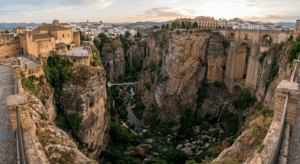
Ronda sits in the mountains of Málaga province in Andalusia, perched at roughly 750 metres above sea level on a plateau split by the dramatic El Tajo gorge. It’s one of the oldest continuously inhabited cities in Spain, with roots stretching back to Celtic and later Roman settlement. The Puente Nuevo — the “new bridge” — was completed in 1793 after 42 years of construction, according to the Ronda Municipal Archive, and connects the ancient Moorish old town (La Ciudad) with the newer commercial quarter (El Mercadillo) across a 120-metre drop.
That context matters before you arrive.
What Is Ronda Spain? (Featured Snippet Block A)
Ronda Spain is a historic clifftop city in Málaga province, Andalusia, built on a plateau divided by the El Tajo gorge at an elevation of approximately 750 metres. It is best known for the Puente Nuevo bridge, one of Spain’s most photographed landmarks, and for being one of the oldest cities on the Iberian Peninsula.
What Ronda Actually Looks Like on the Ground — and Why It Surprises People
Most people assume Ronda is a village. It isn’t.
The city has a population of around 34,000 and functions as a genuine regional hub for the Serranía de Ronda area. There are two distinct sides to the city separated by the gorge, and they feel almost nothing alike. La Ciudad — the old Moorish quarter — is narrow streets, whitewashed walls, Arab baths, and a cathedral built on the foundations of a mosque. El Mercadillo, on the newer side of the bridge, is where locals actually live: supermarkets, tapas bars with no tourist pricing, and the city’s famous bullring.
Travelers who’ve visited Ronda often report being caught off guard by how much the Mercadillo quarter rewards wandering. It doesn’t look like the photographs. That’s the point.
The gorge itself is 300 metres long and between 60 and 120 metres wide. Standing at the mirador (viewing point) on the old town side, looking down at the Guadalevín River far below, is one of those moments that genuinely doesn’t photograph the way it feels. The scale only registers in person.
Ronda also has a serious literary and artistic history that most travel content ignores entirely. Ernest Hemingway wrote about the city’s bullring. Rainer Maria Rilke spent time here and called it one of the most beautiful places he’d ever seen. Orson Welles requested that his ashes be scattered here after his death in 1985 — and they were, at a farm just outside the city belonging to his friend, bullfighter Antonio Ordóñez.
That’s the version of Ronda the Instagram grid doesn’t show you.
Day Trip vs Overnight Stay — An Honest Answer
Here’s the thing: this debate has a real answer, and most travel blogs dodge it.
A day trip from Málaga or the Costa del Sol gives you 5 to 6 hours in Ronda if you catch an early train. That’s enough to see the Puente Nuevo, walk La Ciudad, visit the Arab Baths, and have lunch. You won’t feel cheated. But you will feel like you’ve seen the outline of something rather than the thing itself.
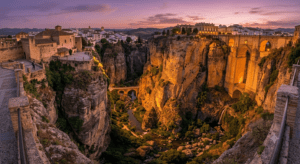
Staying one night changes the experience entirely. The crowds — and they are significant from May through September — thin out dramatically after 6pm. The light on the gorge at dusk is extraordinary. You can eat at places that don’t have menus in four languages. And the following morning, before the first day-trip coaches arrive, the old town is almost silent.
Quick Comparison:
Option | Best For | Key Benefit | Limitation Day trip from Málaga | Tight itineraries, first Spain visit | No accommodation cost, easy logistics | Crowds, rushed, miss the evening light Day trip from Seville | Andalusia circuit travelers | Combines well with Jerez or Cádiz | Long drive (1.5 hrs each way), tiring One night in Ronda | Anyone who can afford the extra day | Full experience, empty streets at dawn | Requires planning ahead in peak season Two nights in Ronda | Hikers, wine lovers, slow travelers | Time for day trips into the Serranía | Ronda town itself is small — fills quickly
Or maybe I should say it this way: if you’re already in Málaga or the Costa del Sol, a day trip is absolutely worth it. If you’re building an itinerary from scratch, one night is the version you won’t regret.
How to Get to Ronda from Málaga, Seville, and Beyond
To get to Ronda by train from Málaga, follow these steps:
- Book via Renfe (renfe.com) — direct trains run from Málaga María Zambrano station.
- Journey time is approximately 1 hour 45 minutes on the scenic mountain route.
- Arrive at Ronda station, a 10-minute walk from the Puente Nuevo.
- Check the return schedule before you explore — service frequency drops in the evening.
- Book in advance during summer; the train fills quickly on weekends.
From Seville, the most practical option is driving (approximately 1 hour 45 minutes via the A-376). There’s no direct train from Seville; connections require a change and take over 3 hours. From Granada, driving takes around 2 hours via the A-92 — it’s a genuinely beautiful route through olive groves and white villages.
Look — if you’re based in Marbella or Fuengirola and don’t have a car, the train from Málaga is the obvious move. Renting a car just for Ronda isn’t necessary unless you’re combining it with villages in the Serranía.
Parking in Ronda is available near the bullring and on Avenida de Andalucía, but the old town streets are not navigable by car. Park once and walk everywhere.
What to See in Ronda — Beyond the Bridge Everyone Photographs
The Puente Nuevo is not the beginning and end of Ronda. It’s just the most famous part.
The Arab Baths (Baños Árabes) are among the best-preserved Moorish bathhouses in Spain, dating to the 13th century. They’re located at the bottom of La Ciudad near the river — most visitors walk straight past the sign without noticing it. Entry costs around €4 and the site is rarely crowded even in peak season.
The bullring — Plaza de Toros de Ronda — is the oldest in Spain, built in 1785, and operates as a museum when corridas aren’t running. I’ve seen conflicting accounts of whether Ronda’s bullring or Seville’s is technically “oldest” — some sources cite the 1785 construction date for Ronda’s permanent stone ring, others note earlier wooden structures elsewhere. My read is that Ronda’s claim is legitimate for a permanent neoclassical bullring of this scale.
The Palacio de Mondragón is a 14th-century Moorish palace that now houses the municipal museum. The gardens alone justify the entrance fee.
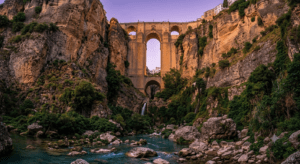
What most guides skip is the walk down into the gorge itself. A path descends from near the Puente Viejo (old bridge) to the riverbed, where you can look back up at all three of Ronda’s historic bridges simultaneously. It takes about 25 minutes down and 35 back up. It’s steep. It’s completely worth it.
https://www.andalucia.com/ronda/puentenuevo.htm
When to Visit Ronda — and When to Avoid It
The honest answer is that Ronda in July and August is not the city at its best.
Temperatures regularly exceed 35°C, the gorge path becomes punishing by midday, and the Puente Nuevo mirador can feel like a queue rather than a viewpoint. The city handles summer tourism well, but the experience is fundamentally different from shoulder season.
March through May is excellent — mild temperatures, wildflowers across the Serranía hillsides, and crowds that haven’t hit their peak. October is arguably the best single month: harvest season for the local wine region (Ronda has its own DO designation, Sierras de Málaga), comfortable walking temperatures, and afternoon light on the gorge that photographers specifically plan trips around.
The Goyesca bullfights in early September are a significant cultural event — Ronda’s annual corrida held in period costume, tied to the style of painter Francisco Goya. Tickets sell out months in advance. If this is on your list, plan accordingly.
December through February is quiet, cheaper, and occasionally dramatic — the gorge can fill with morning mist that makes the city look like something from a film set. Some smaller restaurants and guesthouses close, but the Parador de Ronda stays open year-round.
Quick note: the Parador sits directly on the gorge edge with terrace views that are genuinely among the best in Spain. You don’t have to stay there to have a drink on the terrace — but booking a room here during shoulder season, when rates drop significantly, is something travelers who’ve done it consistently say they’d repeat.
Voice Search
Q: What’s the best way to get to Ronda from Málaga?
A: Train from Málaga María Zambrano station takes about 1 hour 45 minutes and runs multiple times daily via Renfe. It’s scenic, affordable, and drops you a short walk from the city center.
Q: How do I spend one day in Ronda Spain?
A: Start at the Puente Nuevo early, walk La Ciudad old town, visit the Arab Baths and Palacio de Mondragón, have lunch in El Mercadillo, then descend into the gorge before your return train.
Q: Should I stay overnight in Ronda or do a day trip?
A: Day trips work if you’re based in Málaga or the Costa del Sol. But one night transforms the experience — crowds disappear by evening and the gorge at dusk is a completely different city.
Q: Why does Ronda Spain look so dramatic in photos?
A: The city sits on a plateau split by El Tajo gorge, a 120-metre-deep chasm with sheer limestone walls. The Puente Nuevo bridge spans it at the narrowest point, creating a setting with no real equivalent in Spain.
Q: When should I visit Ronda to avoid crowds?
A: October and March through May offer the best balance of weather and manageable crowds. July and August are the busiest and hottest months — avoid midday in summer if you do visit then.